In which we visit poets

Today we took part in Open House Chicago, the annual event sponsored by the Chicago Architecture Foundation that allows any member of the public behind-the-scenes access to ordinarily private spaces.

Of all the places we saw today, A#1 was the Poetry Foundation, best known as publisher of Poetry magazine. In 2007, this magazine, put together with integrity and devotion out of the basement of the Newberry Library, received a colossal gift from philanthropist Ruth Lilly that ensures the magazine will be pretty much immortal. Ruth Lilly’s gift allows an ongoing host of prizes and initiatives that are working hard to move poetry from the ghostly margins to the heart of our society.

Her gift also allows the Poetry Foundation to have its own swell new home, a modernist structure on Superior street that is the site of its offices, its archives, a performance space for live poetry events throughout the year, plus the above, this inviting, gracious, light-filled reading room.  In the library, there are 30,000 books.  There are audio and video recordings.  It is open to all. The librarians are poets.  They are there to help you.

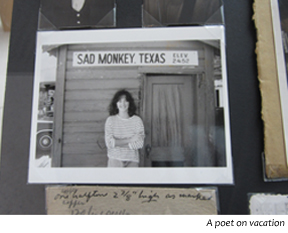
During our visit, we also spent quite a bit of time looking at the current exhibition “Poet Photos: from the Archives of Poetry Magazine” – snapshots submitted to Poetry over the years by its contributors.  The images are mischievously sorted by type – for instance, the poet on vacation, the poet with an animal (rather often, a reluctant cat), and an entire case of poets gazing off into the distance – and are pleasingly unlabeled. I didn’t recognize most of these faces (like me, you will probably be able to identify Allen Ginsberg and also will be able to say, “Hey, there’s an Airedale”), and I found the mystery made this an ever more fascinating window.

This year, friends, marks 100 years of Poetry magazine.

Posted in Uncategorized | Tagged , , , , , , | Leave a comment

All in this together

I just love living here.  This is downtown Chicago, at the corner of Michigan and Washington, across from wonderful Millennium Park.  We were on our way to a night-time performance in the park – possibly opera related? Walking here through the Loop reminded me why I love to live in the city: people from everywhere in the world have chosen to come here, with their ideas and their cooking and their ways of living; everybody has some place to be; and here we all are, all in this together.

Posted in Uncategorized | Tagged , , , | Leave a comment

My morning drive

I don’t drive very much. Here in Chicago, I can get around with mass transit or on foot.  We run around and do errands once or twice a week, and take the occasional road trip, but for the most part we are not very automotive. I get to work every day by walking about a mile through a pleasant, leafy neighborhood to the El, and then riding downtown to work.  It’s about a 15-minute ride. The train stop is in my work building – all I have to do is get off the train and go upstairs.

I had forgotten how wonderful all of that is until this morning, when it took me about an hour to drive about 11 miles – 11 tense, loud, bumper-to-bumper miles packed with jerks fixing their mascara, tailgating, vaguely steering their SUVs while texting – to see my dentist.  One guy was shaving. The whole thing just made me want to get out of the car and start biting people, which at certain parts of the trip would have been entirely possible, given that once or twice we were all at a complete standstill for minutes at a time.  And then there was the fun-filled return trip. People do this every day. People do this every day! Maybe some of you.

I often complain about mass transit here in Chicago. In New York, you can get around like mad on mass transit, but here it is at best kinda convenient, especially since the service cuts of the past couple of years (hey downstate legislators – you’ve heard that cities are engines of prosperity for entire regions, yes?). It’s also antique -hard to access if you are not physically fit, shabby, rickety.

Some members of our family live in cities without decent mass transit.   One of them has to contend with living in Detroit, a sprawling city whose government is now, puzzlingly, shredding its mass transit system, pruning routes and service hard, and in the process ruthlessly cutting people off from their jobs and schools.  Other members of our family live in places that don’t have any mass transit at all. I tell you, that changes your whole life. It makes life expensive, it makes you waste resources. Your car owns you.

At times, we think of leaving Chicago, but I have to admit that the mass transit is one reason we stay. We need to know we can have a life without having a car. And we need to know we are part of something bigger that is contributing to the greater good and not adding to a hotter world.

This year, the CTA has embarked on a project to restore the Red Line, the one that stretches north and south all the way from the border of Evanston to 95th street – a run of nearly 25 miles.  One reason is that the infrastructure just needs it.  Another is that, once the tracks are upgraded and modernized, the Red Line can be extended even farther south.  For years there has been talk about extending the line all the way to 130th street.  That would cover neighborhoods that are cut off from everywhere else if you don’t have a car – like Pullman, which is historic and charming, but so hard to reach that it might as well be in another state.

This photograph was taken in my neighborhood El station, Logan Square, which last year was refreshed by the CTA’s Renew Crew, so that it no longer looks like a post-apocalyptic hideyhole.  It looks fresh, fast and light.  This is the station I take for granted.  It works. I wish everyone could take service like this for granted.

Posted in Uncategorized | Tagged , , , , , , , , , | Leave a comment

Panic button Monday loves a parade

Every time I push the panic button, this shows up.

Posted in Uncategorized | Tagged , , , | Leave a comment

A visit to Montrose Harbor

PTO is always purpose driven here at 9591iris.  Someone has to go to the doctor or is in the hospital, or someone needs help moving, except 1,000 miles away, or we are creating a special dinner for the extended family and in one of those holiday miracles some of the attendees are simultaneously being fetched here from other states.  Or maybe we are on vacation, real, actual vacation, but the action-packed kind of holiday we favor.  A PTO day of just shambling about? Never.

Except today.  Today I have a day off and am just drifting about.  My greatest achievement today has been to pat the more skittish of the cats.  I ate an actual cooked breakfast, cooked by me. I fretted over what to wear to dinner tonight.  And I came here.

This is Montrose Point Bird Sanctuary.  It’s a protected bird area in Chicago, a little thumb of land sticking out into Lake Michigan. We come here on the weekends, from time to time, to watch birds and walk along the lakefront.

Birds on the move, following the shoreline south or north, stop off here to rest, eat and shelter. The entire sanctuary is only 15 acres, and that includes a tiny bit of no-dogs-allowed lakefront.

I’ve seen amazing things here.  A Cooper’s hawk in high-speed pursuit of a sharp-shinned falcon.  Snowy owls.  Short-eared owls.  Countless warblers.  Countless bird watchers, looking for rarities.  In the spring, white-crowned sparrows in the hundreds, who were so cute and ubiquitous that after a few days we stopped looking at them, and then one day, after about three weeks of filling their bellies and hopping about and singing like mad, they were all gone, all together, heading farther north, and we said, Oh no! I miss those guys!

A place like this is not an ark.  It’s more of a little bitty life ring.  A vestigial organ of what was here before.  For birds on the move, following the length of Lake Michigan, it is a mercy, coming after they have flown down the entire length of Lake Michigan, or up across the continent and along the urban, industrial south shore.  This small place offers enough different micro-environments (hedge, woods, pond, lake, beach, meadow) to help almost any kind of bird refuel.

I didn’t expect to see anything awesome today.  It’s the experience of being in this place that I am after – the progress of the seasons, the trees moving in the wind, the open meadow, the hedge, and just beyond, the lake.  Today all the small birds were unaccountably nervous, way beyond the usual, and thus very hard to see.  I could not figure it out.

Then I saw the reason: a big, confident looking red-tailed hawk, which was casually loitering around like this was his personal pantry.  Which, I guess, it was.

The last bird I saw on my way out was a hermit thrush, jabbing at some bug on the footpath.  Realizing I was looking at it, he gave me an instant skeptical once-over and took off.

Stay skeptical, bud.  Hope you make it to Mexico.

Posted in Uncategorized | Tagged , , , , , , , , , | Leave a comment

There’s something happening here, what it is ain’t exactly clear

Detroit is busting out in beautiful graffiti, like this glorious example above stretching around the old Wayne Foundry & Stamping plant.

Something is trying to happen in Detroit, and art is trying to tell us about it. Perhaps the wildest thing is that people want to be there. They are seeking to be there. The rental occupancy rate in the city center is 98 percent. Every time we visit, which is often, we see more and more positive signs.

As one little example, a year ago, we went downtown for dinner, and for the first time in ever, we could not find parking. We could not. The weather was terrible, it was late, but the streets were thronged. People were out walking around and shopping and going places and living their lives. It was just life, but in a way I had not seen downtown for decades.

Who understands the sources of creativity and change? But to see the little explosions of beauty that you find all over Detroit now is to see how the city is psychologically near a crossroads. Much of it is still on the hard desperate path down. A lot has been done to break it. A lot still is being done. But despite that, people want to remake Detroit. Not bring it back, because you can never bring back the dead, but make something new here.

I think of the young people who live in Detroit – the college-educated kids in their 20s and 30s who have moved there in the hundreds and thousands in the last couple of years, but even more the kids who were born there and are growing up there. They are the ones who are hungry to be more and, if they can, make their world more.

Detroit is ready to go beyond the broken places. I am only catching glimpses of that, from a distance, through the window of graffiti like this one.

Posted in Uncategorized | Tagged , , , , , , | Leave a comment

Panic button Monday visits Chicago’s Magic Mushroom Forest

Every time I push the panic button, this shows up.

Posted in Uncategorized | Tagged , , , , , | Leave a comment

If clutter could talk

We do read, at 9591 Iris, we pick up a physical object called a book and we stare at it for hours, even days.

Right now, the book in our hands is If Walls Could Talk: An Intimate History of the Home, by Lucy Worsley.

There is something in this quick little read for everyone, exactly because most of us share the experience of domestic life.  We have rooms called bedrooms that are reserved for sleeping and personal privacy; other, purpose-built rooms where we carry out the rituals of personal hygiene, or cooking, or gathering together, or storage of our possessions.  And we all have come to common understandings about the ways to deal with concerns like waste, body hair, cooking, and relaxation.

Worsley ranges pretty far. Among her topics: cosmetics; beards; heating; the fall, and rise, of bathing; “the striking link between fancy manners and political absolutism”; how duvets revolutionized bedmaking; the arrival of the bathroom, which interestingly has a history of only decades, not centuries; and little excursions into things like shampoo, toilet paper, toothbrushes; the comfy chair; the recipe; the polite smile; and even the linchpin of my domestic existence, clutter.

One of the things I admire about this book is its conclusion.  I am a great reader of popular histories, and this is where so many of them fail, dropping the thread or dragging in the corpses of ideas never mentioned earlier in the text. Worsley’s final comments, though, are wonderful.  With lightness and common sense, she talks about what may come next in our domestic lives: how the warming world, and shrinking resources, will likely reshape the practicalities of our home life: we will have fewer things, wash less often, and look out of smaller windows from smaller rooms.  I think her vision is pretty rosy, but then, she comes from a part of the world where climate change is actually being addressed by public policy, so I understand how she would feel that way.

This book is pretty Brit-centric.  Her discussion of clutter, for instance, focuses on the Victorian mania for overstuffed homes, crammed with shoddy possessions, a behavior she links to social anxiety.  This book was published just last year, but interestingly she avoids mentioning anything about the modern Western (and especially American) home, overstuffed with its own clutter.  Look around you – if you are like most Americans, you are certainly not living in a spare, minimalist environment, surrounded by the bare essentials.  You live in the midst of a lot of little things, and you chose to bring them into your daily life because they not only make your life more convenient but bring you pleasure.

I love my clutter, actually.  The piles of magazines, the throw pillows, the eccentric objects, the pictures.  When I walk in the door at the end of the day, I am always glad to see my things.

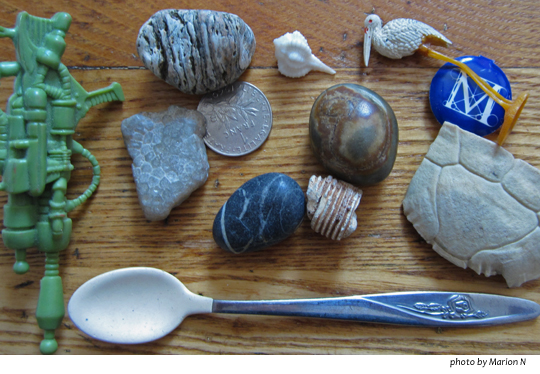
The picture above shows the objects I always take with me when I travel, all in a little bag.  The plastic gun is left over from one of my children’s long-vanished action figures.  The little spoon is what I used to give my kids their first solid food.  The bag also holds a French one-franc coin, a tiny shell from the Florida Keys, a fossil crinoid stem from Missouri, a lapel button from the Metropolitan Museum, a piece of turtle shell found in the woods in Missouri, stones from Nova Scotia and from three Great Lakes – Ontario, Superior and Michigan (yes, that is a Petoskey stone).  I have no idea where that plastic stork came from, but it’s been in my life so long that it probably was not made in China.

I don’t tote these things around out of superstition – they’re not religious relics.  I bring them because they connect me to my life.  My clutter is an emblem of my personal history and my domestic life.  I love my clutter so much that I take it with me.

Posted in Uncategorized | Tagged , , , , | Leave a comment

I’m warning you

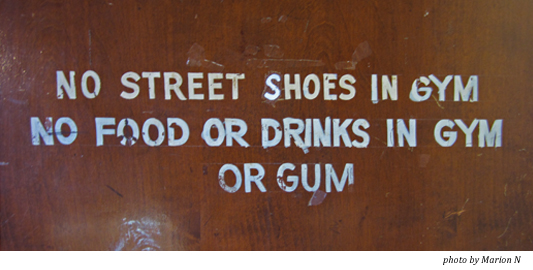
I have a fondness for stenciled signs.  This swell example, one of my all-time favorites, is in a fieldhouse around here that is part of the Chicago Park District. Every time we happen to be in that fieldhouse, which is only two or three times a year since it is not the one in our neighborhood, I go out of my way to find it and gaze upon it.  Partly I do that because, some day, someone is going to decide that this stencil is inappropriate and needs to go, and somehow a sander will be scared up and the end.  But also I look up this old beauty because I just plain love it – the deep brown wood, the very shiny varnish, the sensible warnings, and then that me too! little tail scolding along at the end.

Posted in Uncategorized | Tagged , , , , , | Leave a comment

Great Lakes for sale?

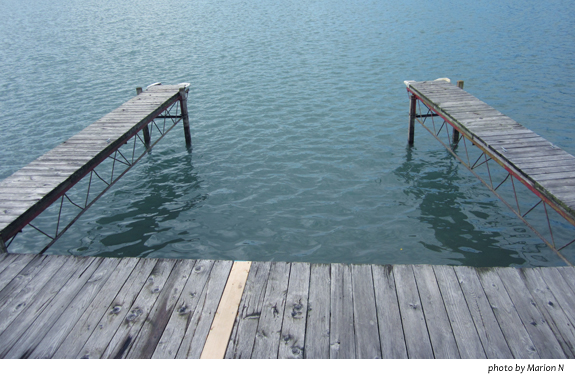
This simple dock, photographed a couple of days ago, is on Skaneateles Lake, one of the Finger Lakes and one of the legacies to us all of the last Ice Age.  Thanks to the retreating glaciers, we have these long beautiful lakes carved into old river valleys in upstate New York, we have flat, rich farmland in places like Ontario, we have the grasslands at the core of our continent and the lakes dotting the Canadian Shield. And we have the Great Lakes, which themselves alone hold more than 20 percent of the world’s fresh water.

Climate change and population growth are giving us a drier, thirstier world.  Places that simply do not have drinkable water, or any water at all, want our water, and plans are hatching to sell it to them.

In case you think a selloff of the Great Lakes is the stuff of Star Trek, think again. Private interests are hard at work on plans to transfer vast amounts of public water to thirsty places. Lake Powell is in the cross hairs; so is Great Slave Lake.  Alaska is in the process of letting a private company sell water from spectacular Blue Lake to a bulk bottling factory in Mumbai.  Two Canadian provinces, Quebec and Newfoundland, are temporarily putting off the start of international bulk-water export operations while the International Joint Commission, the US-Canada governing body of the Great Lakes, studies the water-sale issue.

Yes, that impression you had that the Great Lakes were protected by a regional pact: that impression was false.  In an era when every living thing is a commodity, nothing is protected.

And in case you think water selloff would have no consequences: the Aral Sea used to be one of the four largest lakes in the world.  Soviet irrigation projects changed all that. The lake is now 10 percent of its original size, in four different shallow basins. The water that is left is filthy with toxins and highly saline.  Its plant and animal life is dead.  What used to be the bottom of a fertile lake that supported a rich fishery is now vast stretches of flat shriveled desert. The surrounding land is irreversible desert. Dust storms – and even better, dust that carries salt, pesticides and fertilizers – are a regular part of life thereabouts. The wind lofts these storms across great distances, too, to ruin far-off farmland.  The dust sickens the people – part of the human toll is respiratory disease, anemia and kidney ailments.  Another part of the human toll is displacement – hundreds of thousands have fled. Desert, drought, hunger, poison duststorms, refugees: it is hard to understate the enormity of this decline.

And all this happened in almost no time at all. In 1960, the Aral Sea was as it had been for millennia. This gigantic, irreversible environmental disaster took only 30 years to achieve.

Is this our future?

Are our Great Lakes a commodity?

Posted in Uncategorized | Tagged , , , , , , , , , , , , , , | Leave a comment